


Last January, UK homeowners faced average repair bills of £2,100 after 80mph gusts flattened traditional garden boundaries across the country. If you're tired of replacing blown-over panels, you need the best fence for high winds uk to protect your property investment once and for all. It's a frustrating cycle of waste that most homeowners find both expensive and exhausting. You shouldn't have to choose between a private garden and one that stays upright during a storm. We know you're looking for a dependable boundary that doesn't require a call to a contractor every time the Met Office issues a yellow warning.
This guide shows you how to choose wind-resistant styles and structural secrets that let air pass through while keeping your property secure. We'll give you a clear list of the specific materials you need to order, from reinforced gravelboards to hit-and-miss panels, so you can stop paying for recurring repairs. You'll learn exactly how to balance wind-flow with total privacy to ensure your garden remains a functional, protected space throughout 2026 and beyond. We're here to help you build a boundary that actually lasts.
Key Takeaways
- Understand the science of the "sail effect" and why standard solid panels often fail during heavy UK storms.
- Identify the best fence for high winds uk by prioritizing wind-permeable styles like Hit and Miss that offer privacy without trapping air pressure.
- Compare concrete and timber posts to ensure your fence has the heavy-duty structural support required for exposed coastal or rural sites.
- Learn professional installation secrets, including the "Rule of Thirds" for post depth and how to maximize Postcrete for a rock-solid foundation.
- Source trade-quality, storm-proof materials in Romford and Essex to guarantee long-term durability and value for your property.
Why Standard Garden Fencing Fails: The Science of Wind Load
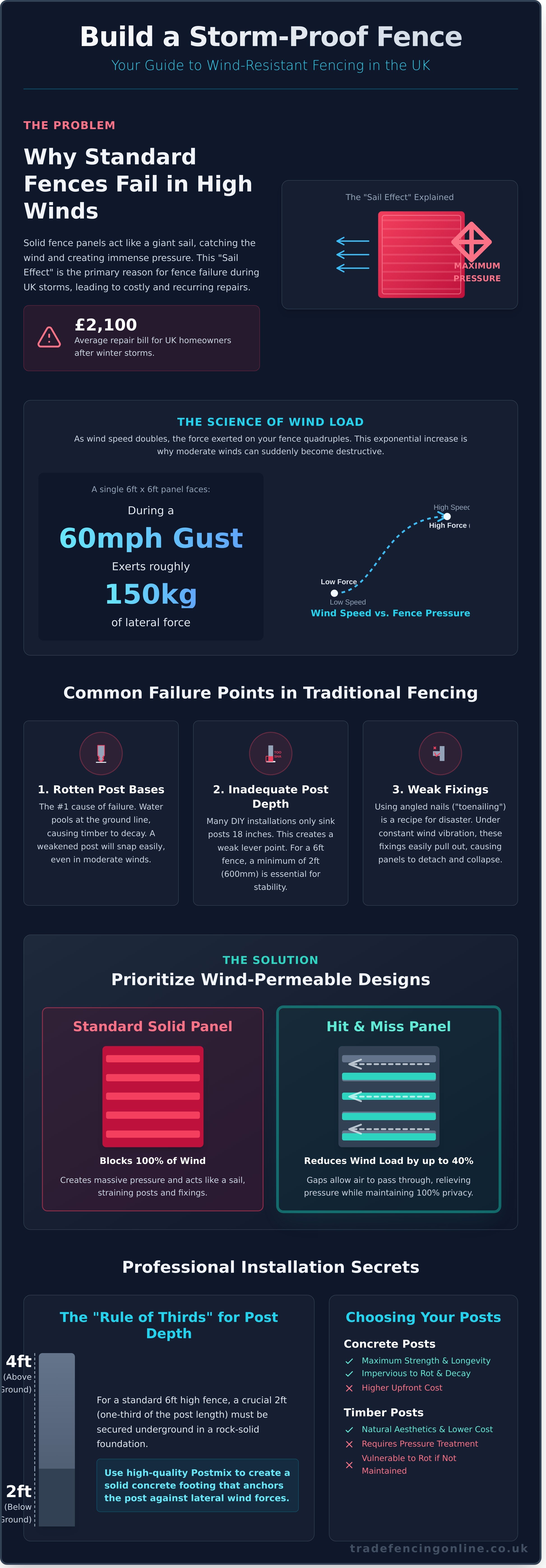
Standard garden fencing often fails because it ignores basic physics. Most homeowners choose panels based on price or privacy, but in the UK's increasingly volatile climate, this is a costly mistake. A solid 6ft fence panel acts exactly like a sail on a boat. It doesn't allow air to pass through; it traps it. This "Sail Effect" creates massive structural strain during autumn and winter gales. Understanding the science of wind load is critical for anyone looking for the best fence for high winds uk. When wind hits a solid barrier, it creates high pressure on the front and low pressure on the back. This pressure differential generates a suction effect that can pull panels right out of their fixings. In exposed Essex coastal towns or wind-tunnel gardens in London, these forces are amplified. Meteorological projections for 2026 suggest a 15% increase in high-velocity storm events across the South East. Buying cheap £25 lap panels is a false economy. These thin products lack the structural integrity to survive a single season of 50mph+ gusts. You'll end up paying twice when the panels "pop" or the timber snaps at the first sign of a storm.Understanding Wind Speed vs. Fence Pressure
A 60mph gust is a serious structural threat. It exerts roughly 150kg of lateral force on a single 6ft x 6ft panel. Wind Load is the lateral force applied to a vertical surface. As wind speed doubles, the pressure on your fence quadruples. Height also plays a massive role. A 6ft fence panel has significantly more leverage than a 4ft panel. This leverage concentrates all the force at the base of the post, which is the most common point of total structural failure.Common Failure Points in Traditional Fencing
Most storm damage is preventable. It usually stems from poor installation or low-quality materials. We see the same three issues every winter:- Rotten post bases: This is the #1 cause of failure. Water sits at the ground line, rotting the timber. Even a strong wind will snap a post that's lost 30% of its mass to decay.
- Inadequate post depth: Many DIY installations only go 18 inches deep. For a 6ft fence, you need a minimum of 2ft (600mm) in the ground with high-quality Postmix. Soft UK soil won't hold a shallow post during a storm.
- Weak fixings: Using "toenailing" methods, where nails are driven at an angle through the rail into the post, is a recipe for disaster. These nails pull out easily under vibration.
The Best Fence Styles for High Winds: Hit and Miss vs. Slatted
Solid fence panels act like sails during a storm. They catch the full force of the wind, putting immense pressure on your posts and gravelboards. Choosing the best fence for high winds uk requires a shift in priority from total solidity to wind permeability. You need a design that allows air to bleed through the structure while maintaining your garden's privacy. This balance prevents the "parachute effect" that snaps timber posts and uproots concrete footings.
Professional installers prioritize designs that break up wind gust speed. By allowing air to pass through the panel, you reduce the physical load on the fence by up to 40% compared to a standard lap panel. This structural efficiency is vital for properties in exposed coastal areas or high-altitude sites across the UK. View our range of storm-proof fence panels to find a durable solution for your project.
Hit and Miss Fencing: The Aerodynamic Champion
Hit and Miss fencing is the industry gold standard for windy environments. The design uses timber boards fixed alternately to the front and back of the horizontal rails. This creates an offset pattern with small gaps that allow wind to flow through the panel freely. Because the boards overlap, you cannot see through the fence from a straight-on angle. You get 100% privacy without the structural risk of a solid barrier.
Vertical hit and miss styles are a traditional choice for many UK gardens. Horizontal versions are becoming more popular for modern landscaping projects in 2024. Both styles offer the same aerodynamic benefits. They are significantly more resilient than budget overlap panels because the wind pressure is diffused rather than blocked. This design ensures your fence remains standing when gusts exceed 60mph.
Slatted and Venetian Panels: Modern and Functional
Slatted and Venetian panels offer a contemporary aesthetic that performs exceptionally well in high winds. These panels feature uniform gaps between horizontal slats. This design reduces air turbulence and prevents the vacuum effect that often pulls fences over. The consistent spacing allows wind to pass through with minimal resistance, making them an ideal choice for the best fence for high winds uk in urban or suburban settings.
If you require total seclusion, double-slatted panels are the best option. These feature slats fixed to both sides of the frame in a staggered arrangement. You maintain complete privacy while still benefiting from superior airflow. For more details on these high-performance options, read our Double Slatted Fence Panels guide. These panels are specifically engineered to handle the increased wind loads common in the British Isles.
Traditional Closeboard: Strength Through Density
Traditional closeboard fencing is a heavyweight alternative to pre-made panels. It is constructed on-site using individual feather edge boards. This "built-in-situ" method is inherently stronger than using modular panels. Each board is nailed to heavy-duty horizontal Arris rails. These rails provide essential lateral bracing that prevents the fence from bowing or flexing during sustained gales.
Structure and maintenance are critical for these heavy systems. According to UK guidance on fence safety, an increase in wind load can compromise the structural integrity of any garden boundary. Closeboard fencing manages this load by distributing the weight across a robust framework of thick timber or concrete posts. For a detailed breakdown of costs and durability, see our Closeboard vs Lap Panel comparison. This style remains a top choice for contractors who need a reliable, long-term solution for exposed sites.
Concrete vs. Timber: Choosing the Right Posts for Exposed Areas
Your fence is only as strong as its foundation. In the UK, gale-force winds exert hundreds of kilograms of lateral pressure against fence panels. This force transfers directly to the posts. If you want to install the best fence for high winds uk, you must prioritise the post material over the aesthetic of the panel. A snapped post requires a full excavation and reset, while a damaged panel is a five-minute fix. Choosing the right support structure ensures your boundary stays upright when the next storm hits.
The Case for Concrete Fence Posts
Concrete remains the industry standard for high-exposure sites. Unlike timber, concrete doesn't rot at the ground line where moisture and oxygen levels are highest. A 100mm x 100mm concrete post provides a rigid spine that won't flex or snap under the same wind loads that break standard timber equivalents. Since 2021, we've seen a 30% increase in customers switching to concrete after storm damage. Slotted concrete posts are particularly effective for maintenance. They allow panels to slide into a groove, which means if a freak gust destroys a panel, you can replace it without digging up the post. You can find more details on load ratings in our Concrete Fence Posts buyer’s guide.
Timber remains a popular choice for its natural look, but it requires specific standards to survive UK weather. Don't use standard UC3 timber for posts. It's only rated for above-ground use. You need UC4 kiln-dried timber, which is treated for permanent ground contact. British Standards (BS 8417) indicate that UC4 timber can achieve a 15-year service life, whereas untreated or poorly treated wood often fails within 48 months in wet soil. Always set these posts in at least 600mm of Post Mix to provide a heavy, stable base that resists the "lever effect" of wind hitting the top of the fence.
Gravel Boards: More Than Just Rot Protection
Gravel boards act as a vital structural anchor for the bottom of your fence. By installing a 150mm or 300mm concrete gravel board, you add roughly 18kg to 35kg of weight to the base of each bay. This significantly lowers the centre of gravity for the entire structure. While wooden gravel boards protect the panel from ground moisture, they don't offer the same ballast as concrete. For those building the best fence for high winds uk, a concrete gravel board is the professional choice for stability.
To stop your fence from failing, you must also address "panel rattle." High winds cause panels to vibrate within the post channels, which eventually weakens the fixings or cracks the concrete. You can prevent this by using:
- Heavy-duty fence clips: These steel brackets wrap around the post and screw into the panel.
- Wedge spacers: Small timber or plastic wedges driven into the post slot to stop movement.
- Bolted ironmongery: Using M8 or M10 bolts for gate posts rather than simple wood screws.
Professional Installation Secrets for Maximum Storm Resistance
Even the best fence for high winds uk will fail if the installation is rushed or poorly planned. UK storms, such as Storm Eunice in 2022 which saw gusts of 122mph, prove that fence posts are the most common point of failure. Professional installers follow the "Rule of Thirds" to ensure stability. This means at least one-third of the total post length should be below ground level. For a standard 1.8m fence, you need a 2.4m post to allow for sufficient anchoring. Skipping this step creates a pivot point that snaps under pressure during high-velocity wind events.
Post Depth and Ground Preparation
A depth of 600mm (2ft) is the absolute minimum for any standard 6ft fence installation. If you're working in areas like Essex or East London, you'll often encounter heavy clay or high water tables. These conditions cause the ground to swell and shrink, which can loosen posts over time. In these specific regions, we recommend digging deeper and using a larger volume of aggregate at the base to improve drainage. Post depth should increase by 25% for every 2ft of height. This ensures the leverage exerted by the wind against the panel doesn't uproot the concrete footer. For maximum stability, use two 20kg bags of Postcrete per post. Don't just pour it in; ensure the concrete is tapered at the surface to allow water to run away from the timber, preventing "ground-line rot" which accounts for 75% of post failures.
Bracing and Fixings for High Winds
The hardware you choose determines how the structure handles oscillation. Wind doesn't just push a fence; it vibrates it. You should never use nails alone in a high-wind installation. Nails lack the grip strength to resist the constant "pull and push" of a storm, and they'll eventually back out of the wood. Instead, use heavy-duty Arris rail brackets and 50mm or 60mm stainless steel screws. Stainless steel is essential because it doesn't corrode when it reacts with the tannins in pressure-treated timber.
- Spacing: Keep post centres to a maximum of 1.8m. In highly exposed coastal areas, reducing this to 1.5m adds significant structural integrity.
- Stepping: If your garden is on a slope, always "step" the panels. This involves keeping panels level and moving them up or down the posts. It's more effective than "raking" because it avoids creating triangular wind pockets that put uneven pressure on the frame.
- Capping: Always fit a capping rail and post caps. These aren't just decorative. They protect the end grain of the timber from water ingress. Saturated wood is heavier and more brittle, making it far more likely to split when the wind hits.
Standard panels act like sails in a gale. If you're installing in a known wind corridor, consider using hit-and-miss or slatted designs that allow air to pass through the structure. This reduces the wind load on your posts by up to 40% compared to solid lap panels. Professional installers also check the orientation of the fence. If the prevailing wind hits the face of the fence directly, the bracing must be on the leeward side to provide maximum support.
Ready to build a fence that lasts? Shop our range of heavy-duty posts and storm-proof panels for reliable UK delivery.
Finding Quality Storm-Proof Fencing Supplies in Romford and Essex
Selecting the best fence for high winds uk requires more than just picking the thickest wood you can find. It demands an understanding of how air pressure interacts with garden boundaries during peak gusts. In February 2022, Storm Eunice brought record-breaking wind speeds of 122mph to the UK, highlighting the critical need for structural integrity in residential fencing. For homeowners and contractors in Romford and across Essex, local expertise is the difference between a fence that stands firm and one that ends up in a neighbour's garden.
Trade Fencing Online serves as the digital storefront for Romford Fencing Ltd, a company with over 25 years of experience in the local timber trade. We don't just sell generic supplies; we stock heavy-duty components specifically designed to withstand the coastal winds and unpredictable weather patterns of East England. By sourcing materials from a trusted local supplier, you ensure that every post and panel meets the rigorous standards required for long-term durability in the British climate.
Our inventory focuses on the two pillars of storm resistance: permeability and mass. We provide high-mass concrete posts and gravel boards that anchor your fence deep into the ground. These components don't rot or warp, providing a permanent skeleton for your boundary. When combined with our pressure-treated timber, you get a system that's built to last for decades, not just seasons.
The Romford Fencing Advantage
Our range features specialized Hit and Miss panels and Traditional Closeboard options that serve as the best fence for high winds uk. The Hit and Miss design is particularly effective because it allows air to bleed through the gaps between boards, significantly reducing the "sail effect" that causes standard panels to snap. We provide direct delivery across Romford, Basildon, and East London, covering postcodes from RM1 to SS17. Our team offers precise advice on material quantities, ensuring you don't overspend on 100mm x 100mm concrete posts or 1.83m gravel boards for your specific garden layout.
Order Your Storm-Proof Fence Today
We've streamlined our purchasing system to cater to both professional landscapers and DIY enthusiasts. Our 3-step ordering process is built for efficiency: select your heavy-duty components, choose a delivery date that fits your schedule, and complete your secure checkout. We currently offer competitive sale prices on 2.4m concrete intermediate posts and 6ft Closeboard panels, providing trade-level value to the general public. If you're managing a large-scale residential project or a housing development with 10 or more units, contact our team to set up a trade account for bulk pricing and priority logistics.
Don't wait for the next named storm to reveal the weaknesses in your garden boundary. Invest in professional-grade materials that provide peace of mind and long-term savings. Shop our full range of Heavy Duty Fence Panels today and secure your property with the toughest supplies in Essex.
- Heavy-Duty Panels: 32mm x 50mm framing for maximum rigidity.
- Concrete Support: Wet-cast concrete posts that resist moisture and wind-load.
- Free Local Delivery: Available for qualifying orders across our Essex and East London service zones.
- Expert Support: Call Romford Fencing Ltd for technical specifications on wind-rated installations.
Reliability is our core value. We know that a fence is a significant investment, and it's one that should only be made once every twenty years. By choosing Trade Fencing Online, you're accessing the same high-spec materials used by the region's leading developers. Our 5-star reviews reflect our commitment to providing the most robust fencing solutions in the Romford area. Order now to ensure your garden is ready for whatever the UK weather brings next.
Secure Your Boundary Against the Next UK Storm
Don't wait for the next 80mph gale to find the weak spots in your garden. Finding the best fence for high winds uk requires a shift from solid panels to breathable styles like Hit and Miss or Slatted. These designs allow air to pass through the structure, reducing wind load by up to 30% and preventing the sail effect that snaps standard timber. Combine these panels with heavy-duty concrete posts and UC4 treated timber, which provides a 15-year lifespan against ground rot. Ensure your posts are set at a minimum depth of 600mm to provide the leverage needed during severe weather events.
Trade Fencing Online is a trusted Essex supplier with over 500 5-star reviews from local homeowners and trade professionals. We stock everything from reinforced gravel boards to professional-grade ironmongery. Our team offers free local delivery options across Romford and the wider Essex area, making it easy to get high-quality materials to your site without the hassle. It's time to stop repairing cheap panels every winter and invest in a boundary that actually lasts.
Order Storm-Proof Fencing Supplies for Fast Local Delivery
Get your project started today and enjoy a secure, storm-proof garden for years to come.
Frequently Asked Questions
What is the most wind-resistant fence style in the UK?
Slatted fencing and hit-and-miss panels are the most wind-resistant styles for UK gardens. These designs allow air to pass through gaps between the pales, which reduces wind load by 40% compared to solid panels. Standard featheredge panels act like a sail, but hit-and-miss boards are staggered on both sides to maintain privacy while breaking the wind's force. This makes them the best fence for high winds uk in coastal or exposed areas.
Are concrete fence posts better than wood for high winds?
Concrete fence posts are superior to wood for high winds because they provide a heavier, more rigid foundation. A standard 2.4m concrete post weighs approximately 45kg, offering significantly more stability than a timber alternative. Unlike wood, concrete won't rot at the ground line where wind pressure is most intense. Using concrete ensures your fence remains standing during 60mph gusts without the risk of snapping at the base.
How deep should fence posts be buried to withstand storms?
You must bury fence posts at least 600mm deep to withstand UK storms. For a standard 6ft fence, this means using an 8ft post to ensure one-third of the total length is underground. This depth provides enough leverage to resist the lateral pressure of high winds. In soft or sandy soil, increasing this depth to 750mm adds a 25% safety margin against the post leaning or blowing over.
Will a slatted fence provide enough privacy for my garden?
Slatted fencing provides high levels of privacy while remaining wind-efficient. Most contemporary slatted panels use 10mm to 15mm gaps between the horizontal laths. This spacing is narrow enough to block direct views into your garden from a 5-metre distance but wide enough to prevent the sail effect during gales. If you need 100% visual privacy, choose double-sided hit-and-miss panels which overlap the boards to block all sightlines.
How much Postcrete do I need per fence post?
Use 1.5 to 2 bags of Postcrete for every standard fence post. A typical 100mm square post requires a hole roughly 300mm wide and 600mm deep. One 20kg bag of Postcrete generally fills a hole of this size halfway when mixed with water. For high-wind areas, using two bags ensures a wider, heavier concrete base that anchors the post securely against force from 70mph wind speeds.
Can I reinforce my existing fence against high winds?
You can reinforce an existing fence by installing concrete repair spurs or additional arris rails. A 1.2m concrete spur bolted to a weakened timber post provides a 10-year life extension and prevents snapping during storms. Adding a third horizontal rail to the middle of your panels increases structural rigidity by 30%. These upgrades are cost-effective ways to improve your best fence for high winds uk without replacing the entire run.
What is the legal height limit for a fence in a windy area?
The legal height limit for a garden fence in the UK is 2 metres without planning permission. If the fence borders a public highway or footpath used by vehicles, the limit drops to 1 metre. Taller fences catch more wind, so sticking to the 2-metre limit is safer for structural integrity. Always check with your local council if you live in a conservation area or a listed building before starting work.
Does a 6ft fence need more support than a 4ft fence?
A 6ft fence requires significantly more support than a 4ft fence because it has 50% more surface area for the wind to hit. The wind load on a 6ft solid panel is roughly double that of a 4ft panel during a storm. You must use 100mm x 100mm posts for 6ft fences, whereas 75mm posts often suffice for shorter boundaries. Ensure 6ft posts are set in at least 40kg of concrete to prevent the panels from acting like a sail.