


The constant rattling and banging of fence panels in the wind is more than just an annoyance; it’s a sign of an insecure installation. Choosing the correct hardware is essential for a sturdy, quiet boundary, but with so many different fence clips available, it’s easy to feel unsure. Selecting the wrong type for your specific panel and post combination can lead to wasted time, money, and a fence that fails to provide the security you need.
This practical guide removes the guesswork. We provide clear, straightforward information on every type of fence clip, from standard U-clips to secure panel brackets. You will learn how to confidently identify the right clip for your job, determine the correct quantity per panel, and follow the simple installation steps. By the end, you’ll have the knowledge to purchase the right hardware and build a secure, rattle-free, and long-lasting fence-correctly, the first time.
What Are Fence Clips and Why Are They Essential?
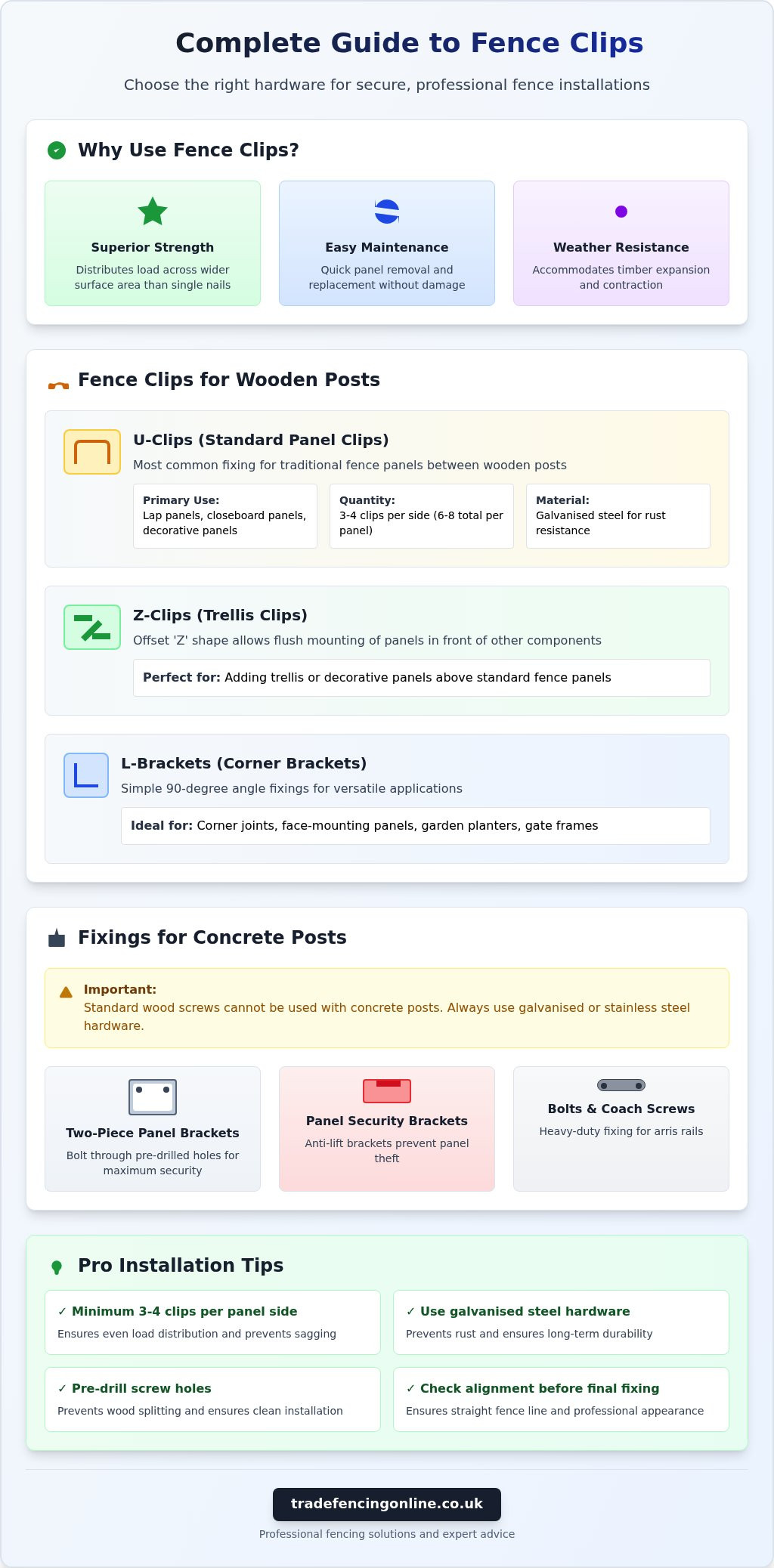
Fence clips are a vital piece of fencing ironmongery, small metal brackets designed to securely attach fence panels to timber or concrete posts. They are the modern, professional alternative to directly nailing or screwing panels into place-a method that often leads to split wood and difficult repairs.
Their primary role is to provide strength and stability across the entire fence line. By using the correct clips, you create a fixing that is far superior to a single nail or screw. This principle of using specialised hardware for secure connections applies across all types of fencing, from garden panels to the specific insulators and connectors required for electric fence components. For any quality fencing project, using the right clip is non-negotiable for a professional, long-lasting installation.
Security and Longevity
A fence must withstand high winds and changing weather. A clip fastens a panel to a post across a wider surface area than a nail, distributing the load and preventing the fixing point from failing under stress. This design also allows for the natural expansion and contraction of timber through the seasons. Unlike a rigid nail fixing that can cause wood to split as it moves, a clip accommodates this movement, significantly extending the life of both your panels and posts.
Ease of Maintenance and Repair
One of the most practical benefits of using fence clips is the ease of future maintenance. If a panel becomes damaged, it can be quickly unbolted and replaced with minimal effort. Compare this to a nailed-in panel, which often requires a crowbar to remove and can cause damage to the adjoining posts in the process. Using clips not only saves time and money on repairs but also gives your finished fence a clean, professional look that is simple to maintain.
The Main Types of Fence Clips for Wooden Posts
Choosing the correct fixings is essential for a secure, long-lasting fence. While there are many methods for attaching panels to timber posts, using the right fence clips ensures a professional finish and robust construction. The principles of secure attachment are universal, as detailed in comprehensive guides like the University of Georgia's Fences for the Farm, which highlights the importance of quality hardware. For standard UK garden fencing, three main types of clips cover almost every requirement.
Below, we outline the most common and effective fence clips for timber-to-timber installations, helping you select the right product for your project.
U-Clips (Standard Panel Clips)
U-Clips, often called standard panel clips, are the most common fixing for securing traditional fence panels between wooden posts. Their distinctive 'U' shape is designed to wrap securely around the vertical batten on the side of a fence panel, providing a solid connection point for screwing into the post.
- Primary Application: The go-to choice for attaching lap panels, closeboard panels, and most decorative panels into the recess between two fence posts.
- Quantity Needed: For a secure fit, we recommend using a minimum of three to four clips per side of the panel (six to eight clips per panel in total).
- Material: Typically manufactured from galvanised steel, providing excellent resistance to rust and ensuring durability throughout the seasons.
Z-Clips (Trellis Clips)
As the name suggests, Z-Clips have a distinct offset 'Z' shape. This design is not accidental; it serves a very specific purpose. The offset allows you to attach a panel in front of another component while keeping the faces flush.
Their primary use is for adding a trellis or a smaller decorative panel above a standard fence panel. The bottom of the 'Z' screws to the top of the main panel, while the top of the 'Z' provides a fixing point for the trellis. This creates a neat, seamless transition with no awkward gaps.
L-Brackets (Corner Brackets)
L-Brackets, also known as corner brackets, are simple but incredibly versatile 90-degree angle fixings. Their strength and straightforward design make them a valuable piece of ironmongery for various fencing and garden construction jobs.
While they can be used to secure panels, their main strength lies in creating strong corner joints or when you need to attach a panel to the face of a post rather than between posts. They are also ideal for bespoke projects, such as building garden planters, securing gate frames, or reinforcing other right-angled timber connections.
Choosing the Right Fixings for Concrete Posts
Concrete posts offer superior strength and longevity, but they require a different approach to fixing. You cannot use standard wood screws, and traditional timber fence clips are incompatible. Attaching panels to slotted concrete posts demands specific hardware designed to provide a secure, durable, and corrosion-resistant connection that matches the lifespan of the posts themselves.
Using the correct fixings is not just about stability; it's about preventing damage and ensuring your fence remains secure for years. Always opt for galvanised or stainless steel hardware to prevent rust, which can stain the concrete and weaken the fixing over time.
Two-Piece Panel Brackets
For a truly robust installation, two-piece panel brackets are the professional's choice. These brackets bolt directly through the pre-drilled holes found in most concrete posts. The two parts clamp securely around the vertical timber batten of your fence panel, creating an exceptionally strong connection that eliminates rattling in high winds and provides excellent structural support.
Panel Security Brackets
A simple yet highly effective solution for security-conscious homeowners. Panel security brackets, often called 'anti-lift' brackets, are small L-shaped fixings that are screwed to the top of the fence panel's side batten. The bracket sits inside the post's slot, making it impossible for the panel to be lifted out from above. This is a low-cost and essential upgrade to prevent panel theft or unauthorised access.
Bolts and Coach Screws
For building closeboard or featheredge fencing, concrete posts often feature pre-drilled holes to accommodate arris rails. In this case, heavy-duty coach bolts or coach screws are used to fix the rails directly to the post. Just as specialised Livestock Fencing Systems rely on specific fasteners for high-tensile wire, your domestic fence needs the correct gauge and length of bolt for a secure fit. Ensure your chosen bolt is long enough to pass through the rail and post with enough room for a washer and nut, but not so long that it protrudes dangerously.
Speciality Clips and Problem-Solving Hardware
Beyond standard installation, a range of specialised hardware exists to solve common fencing issues and provide a professional finish. These problem-solving components are often overlooked but can make a significant difference to the longevity and performance of your fence. They are designed to save you time, money, and frustration by addressing everything from annoying noises to major structural repairs. Investing in the right fence clips and hardware ensures a secure, long-lasting boundary.
Anti-Rattle Clips (Panel Grips/Wedges)
One of the most frequent complaints with panel fencing is the rattling sound panels make inside concrete posts during windy weather. This noise is not just an annoyance; it also signifies wear and tear on the panel. Anti-rattle clips, also known as panel grips or wedges, offer a simple and extremely low-cost solution. These small plastic or rubber wedges are pushed firmly into the gap between the fence panel and the post, creating a tight, secure fit that completely stops movement, eliminates noise, and prevents damage.
Fence Post Repair Spurs
When a timber fence post rots at ground level, it compromises the integrity of your entire fence line. Rather than undertaking the major job of replacing the post and disturbing the attached panels, a fence post repair spur provides a durable, professional fix. Available in solid concrete or galvanised metal, the spur is concreted into the ground alongside the damaged post. Once set, the original post is securely bolted to the spur, restoring full strength and stability for years to come.
Arris Rail Brackets
For those building traditional closeboard fencing, arris rail brackets are essential pieces of ironmongery that save significant time compared to morticing posts. These strong, galvanised steel brackets are designed to fix triangular arris rails securely between timber or concrete posts, creating a solid framework for the featheredge boards. We supply a complete selection, including both standard brackets for straight fence lines and specialised corner brackets for navigating 90-degree turns. View our full range of fencing ironmongery to find the right components for your project.
Installation Guide: How to Choose and Fit Fence Clips
Fitting fence panels correctly is essential for a long-lasting, secure boundary. Using the right fence clips and fixings makes the job faster and ensures a professional, durable result. This guide provides a straightforward, no-nonsense approach to selecting and installing your clips.
Choosing the Right Material and Finish
The material of your clips is critical for weather resistance. For UK gardens, galvanised steel is the industry standard and our recommended choice. It offers excellent protection against rust at a great value. While stainless steel provides superior corrosion resistance, it is often unnecessary for typical fencing projects. Powder-coated clips offer a decorative finish but can be prone to chipping, which exposes the metal underneath to rust. Always pair galvanised clips with galvanised screws to prevent unsightly rust streaks running down your fence posts.
How Many Clips Per Panel?
Using the correct number of clips provides the strength needed to withstand wind and prevent rattling. Follow this simple rule for a secure installation:
- For 4ft and 5ft panels: Use 3 clips per side (6 clips per panel).
- For 6ft panels: Use 4 clips per side (8 clips per panel) for extra stability.
If your property is in a particularly windy or exposed location, we advise adding an extra clip per side. This is a low-cost measure that adds significant strength to the finished fence.
Basic Installation Steps (for U-Clips)
For this guide, we will focus on standard U-Clips, the most common type used for panel fencing. You will need a drill, screwdriver bit, tape measure, and pencil.
- Mark Positions: Offer the fence panel up to the post, using blocks to hold it at the correct height. Use a pencil to mark the post at the top and bottom of the panel’s side battens. Then, mark the evenly spaced positions for your clips.
- Fix Clips to the Post: Remove the panel. Position your first clip on the markings and screw it securely to the fence post. Repeat for all clips on both posts, ensuring they are level and correctly aligned.
- Secure the Panel: Carefully slot the fence panel back between the posts, resting it in the clips. Drive a screw through the side hole of each clip directly into the panel’s wooden frame to lock it in place. Pro Tip: To avoid splitting the timber, pre-drill small pilot holes before fixing the screws.
Following these steps will ensure your fence is secure, professional, and built to last. For a complete range of quality fencing ironmongery, including galvanised clips and screws, visit Trade Fencing Online, your one-stop-shop for everything fencing.
Final Steps: Securing Your Fence with Quality Clips
Building a durable and secure fence comes down to getting the details right. As this guide has shown, selecting the correct hardware is not an afterthought-it's fundamental to your project's success. The most critical takeaways are to carefully match your clips to your post material, whether timber or concrete, and to ensure a firm, correct installation. By understanding the function of different fence clips, from standard U-clips to specialised repair brackets, you empower yourself to complete the job efficiently and to a professional standard.
When you are ready to purchase the right fixings, look no further than Trade Fencing Online. As a trusted local supplier in Essex, we pride ourselves on stocking a wide range of quality fencing ironmongery for every application. We provide the reliable hardware that trade professionals and DIY enthusiasts depend on. Take advantage of our fast local delivery options to get your project started without delay.
Shop our full range of quality fence clips and fixings today and build a fence that stands strong for years to come.
Fence Clips: Frequently Asked Questions
How many fence clips do I need per panel?
For a standard 6ft (1.8m) fence panel, we recommend using a minimum of four clips, with two on each side. This provides a secure fixing for most conditions. For taller panels over 6ft, or for fences in areas exposed to high winds, using six clips (three per side) is advised for superior strength and stability. Always ensure an even spacing between the clips for balanced support and a professional finish.
Can you use screws instead of fence clips to attach panels?
While it is possible to screw panels directly to posts, it is not the recommended method. Screwing directly into the panel frame can cause the timber to split and can trap moisture, leading to rot. It also makes replacing a single panel much more difficult. Using purpose-made fence clips provides a more secure, durable fixing that allows for natural timber movement and simplifies future maintenance or repairs.
How do you stop fence panels from rattling and banging in the wind?
Rattling panels are usually caused by a small gap between the panel and the fence post. The most effective solution is to ensure a tight fit during installation using the correct size of fence clips. If your existing panels are rattling, you can insert small, treated timber wedges or packers into the gap to eliminate movement. This simple fix creates pressure and stops the panel from moving and making noise in windy conditions.
What are the best clips to use for concrete fence posts?
Standard concrete posts are designed with a groove for fence panels to slot directly into, so clips are not usually required for this type of installation. The panel is held securely within the channel of the post. However, if you are fixing a panel to the face of a concrete post or wall, you will need to use a U-clip or bracket. This must be secured to the concrete using appropriate masonry screws and wall plugs.
Are all fence clips a standard size?
No, fence clips are not all a standard size. They are manufactured to accommodate different fence panel thicknesses, which typically range from around 40mm to 50mm. It is critical to measure the thickness of your fence panels before purchasing clips to ensure you get the correct size. Using a clip that is too large will result in a loose, rattling panel, while one that is too small will not fit at all.
What's the difference between a U-clip and a Z-clip?
The key difference is their shape and specific use. A U-clip, also known as a panel security bracket, is shaped like a 'U' and is used to fix a standard fence panel to the face of a timber post. A Z-clip is shaped like a 'Z' and is designed specifically for building traditional closeboard fencing. Its purpose is to attach the end of a triangular arris rail securely to a fence post.